Posts

How do we think about God's law?

Image
Today’s readings invite us to reflect on how we think about God’s law.  Laws can set us on a path of binary thinking:  Do this, not that.  Follow this list of rules.  Do not cross that line in the sand.  Obey the law, and be rewarded.  Disregard the law, and be punished.   Laws are routinely misused by those in power to suppress, exclude, and burden.  Yet at their core, God’s laws are neither good nor bad.  They are a set of guidelines; community norms; policies and procedures; boundaries that exist to help us maintain healthy relationships with God and one another.  They are the essential framework guiding every aspect of our common life.   Like the rules parents give their children, they are meant to help us thrive. They are meant to guide us towards a life of abundance and joy, while cautioning us against choices that can lead to scarcity and loneliness.  Our first reading is from Sirach ,  a book within the Apocry...

How do we respond to the Herod-like figures in our lives?

Image
Each Epiphany we hear  this gospel text from Matthew , featuring the holy family, wise men, and Herod the Great.  This year, I thought we might explore some of the antagonistic behaviors of Herod.  There are some similarities between Herod’s choices and behaviors, and those we’ve seen in recent history on the news, and to a lesser extent, experience in our lives and within ourselves.   How do we respond to the Herod-like figures in our lives?  Or the Herod-like behaviors within ourselves? But first, let’s begin with Herod.  Biographers describe Herod the Great as a complicated figure.*  The Roman Empire appointed him to govern the region of Judea on their behalf, promoting Hellenistic culture, better known to us as Greek culture.  He worked well under Caesar, Cassius, Antony, and Octavian Augustus, quickly shifting allegiances with every change in leadership.  Yet Herod was not from a Roman background himself.  He was an aristocrati...

What does John the Baptist have to teach us?

Image
  Today’s gospel lesson features John the Baptist.  John was a prophet and contemporary of Jesus.  To find him, folks would make their way into the wilderness of Judea.   His clothes were made of camel’s hair; while his diet consisted of locusts and honey.  John’s prophetic message called on God’s people to repent; or in other words, to turn their hearts and minds back towards God’s dream for this world.  Those moved by John’s message, would partake in a ritual cleansing and recommit to God by being dipped or immersed in water.  Hence his nickname as a baptizer.  John was that unique kind of eccentric person, who has a way of making you feel deeply uncomfortable, and yet at the same time, you can’t quite turn away.  He captivated people's senses.  Prophets often have this skill.  As God’s messengers, they are called to speak to particular communities facing their own individual concerns.  Yet the themes are often the same....

Swords to Plowshares

Image
Yesterday, our family joined folks from across our diocese for an event they co sponsored with Christ Trinity, Sheffield; St. Paul’s Stockbridge; Grace, Great Barrington; and Swords to Plowshares Northeas t. The Rt. Rev. Jim Curry, a retired Bishop Suffragan in Connecticut is the chief blacksmith for Swords to Plowshares. This ministry was inspired by the prophet Isaiah, who proclaimed: “...they shall beat their swords into ploughshares…” (2:4) Their organization works with local police departments, taking guns that have been bought back from the community and then turning them into garden tools. What we witnessed yesterday was beautiful, and I will tell you why, but first, I want to share why I think addressing gun violence matters so much. For me, it’s always been personal. My father was an avid hunter. He was also an alcoholic, whose disease took over his life during the course of my early childhood. When I was four years old, my mom came home from her shift at the naval air stati...

Teaching Sermon: The Christian Scriptures

Image
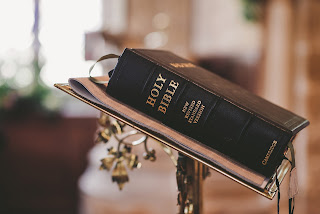
Last month, Molly offered the first of two teaching sermons on the Christian Bible.  She focused on the  Hebrew Scriptures , and began by talking about the labels we use when referring to these sacred texts.  The Hebrew Scriptures are better known in Christian circles as the Old Testament , and are sometimes referred to as the  First Covenant .  Like Molly, I don't use the label Old Testament   because of its negative connotations.  Instead, like many others, we refer to these sacred texts as the Hebrew Scriptures .   For me, this label is a helpful reminder that Jesus of Nazareth, in birth and death, was a practicing Jew; and that these sacred texts were the ones he learned, inwardly digested, and informed his teachings of God’s love and grace. Today, I’ll offer the second teaching sermon on the Christian Bible, focusing on the Christian Scriptures.  These sacred texts are better known in Christian circles as the New Testament , and are...